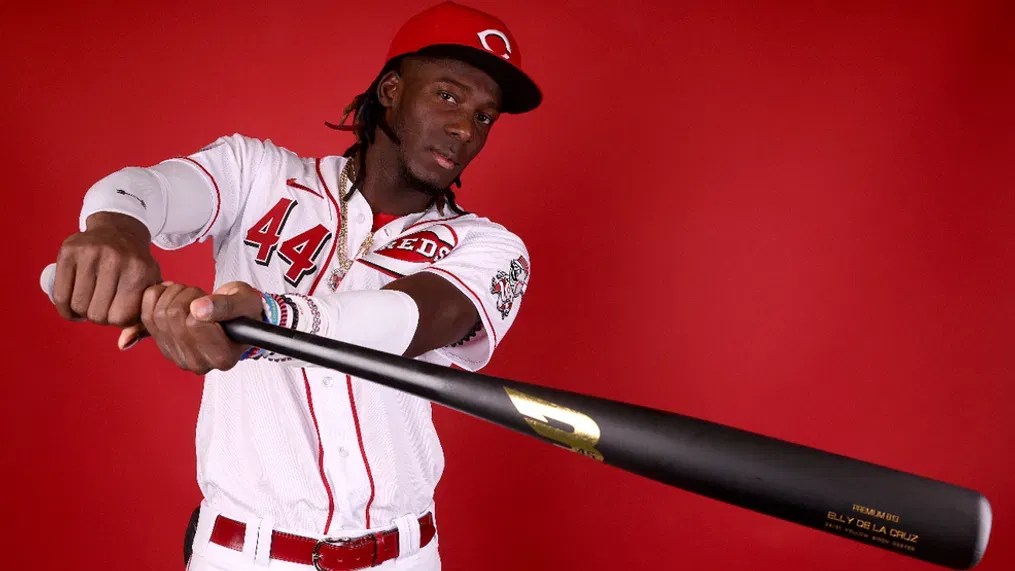
Every year numerous publications and prognosticators release Top Prospect lists. Most years there is a consensus number one. However, in baseball the top draft pick can take years to make their appearance in the league and sometimes they never make it at all. Baseball differs from the other major sports in this regard. The fact that a call-up can happen at literally any time during the season creates a certain anticipation and only adds to the excitement.
On June 6th the Cincinnati Reds called up their top prospect, Elly De La Cruz, to make his Major League debut. De La Cruz is a 6’5″ switch-hitting shortstop with elite tools. He is regarded by most accounts as the top prospect in all of baseball. His highly anticipated big league arrival set the baseball world on fire and Elly didn’t disappoint. He went 1-3 and displayed his highly graded speed with a double that most players would’ve only gotten a single out of. In his second game he launched a massive home run in the first inning that almost left the stadium and again showed off his wheels, adding a triple later in the contest. All of the De La Cruz hype and buzz made me think of all the top prospects throughout the years and inspired this list of The Top MLB Prospects…Of My Lifetime.
10. Gregg Jefferies
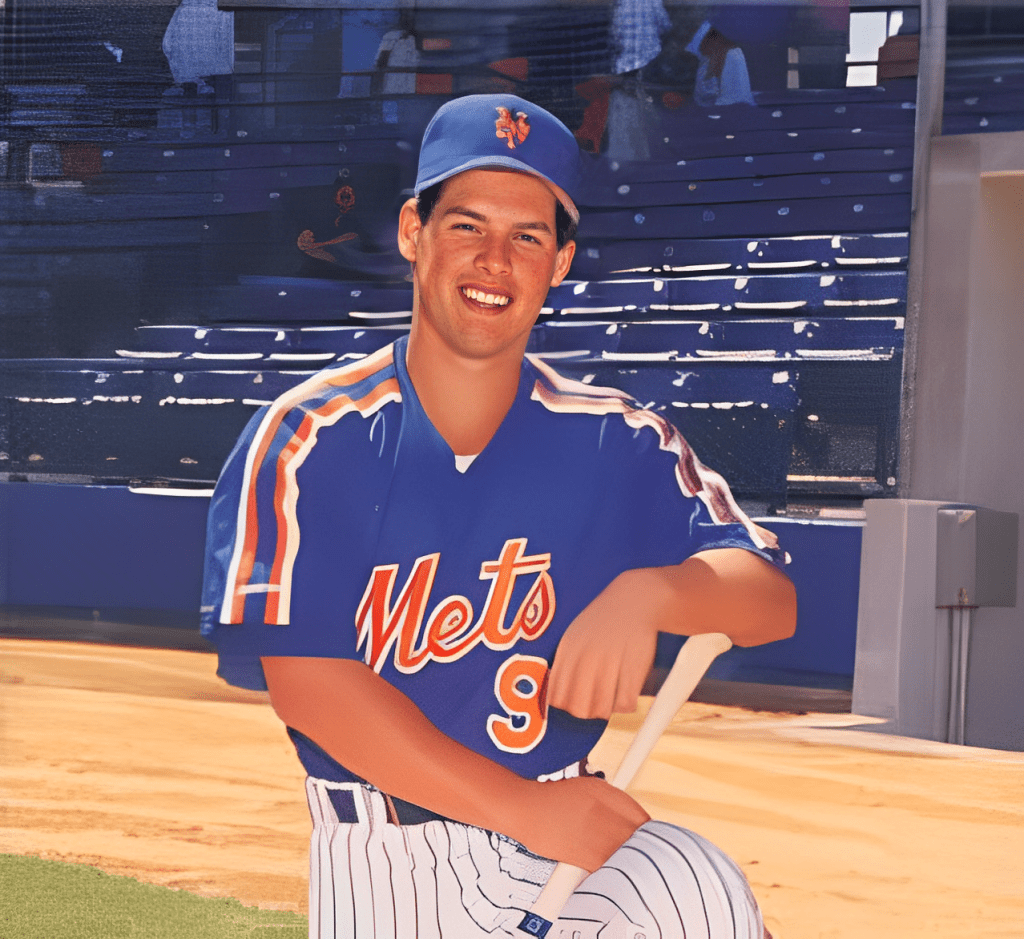
Gregg Jefferies was a baseball prodigy who was “encouraged” by his father to dedicate himself to the sport. His baseball development was aided by intense workouts. Eight hours a day, six days a week. All of Jefferies hard work paid off when he was selected in the first round (20th overall) by the New York Mets in the 1985 draft. Gregg tore through the minors and was named Baseball America’s Minor League Player of the Year for both 1986 and 1987, becoming the first player to receive that distinction in consecutive years. Back at the time when Jefferies was a prospect the only way I really had of knowing who the top minor league guys were was from baseball cards. I knew Jefferies was special from reading the backs of his cards and from the fact that every major card company had Jefferies cards before he’d ever set foot on a Major League field. Jefferies never really lived up to his uber-prospect status but still had a decent MLB career, making two All-Star teams and finishing his 14 year career with a .289 lifetime batting average.
9. Josh Hamilton
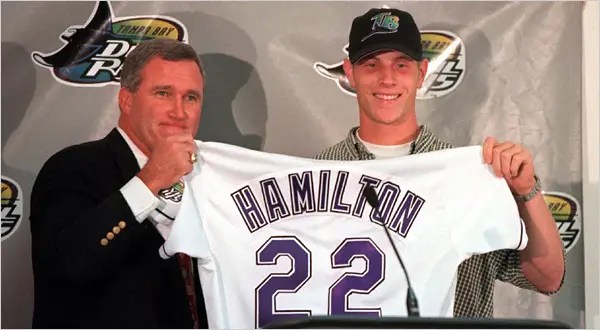
After hitting .529 in 25 games with 13 home runs, 20 stolen bases, 35 RBIs, and 34 runs scored during his senior season with Athens Drive High School in Raliegh, Josh Hamilton was selected 1st overall by the Tampa Bay Devil Rays in the 1999 MLB draft. He was on the fast track to the majors until he was injured in an automobile accident prior to the 2001 season. The accident led to Hamilton’s career and life taking a drastic turn. It marked the beginning of a lengthy battle with drugs and alcohol, which Hamilton would continue to fight throughout his career. He was out of baseball entirely for almost three years before making a comeback. After being left off Tampa Bay’s 40-man roster he was selected in the Rule 5 draft by the Chicago Cubs who immediately traded Hamilton to the Cincinnati Reds. Eight years after being drafted Hamilton made his Major League debut with the Reds on April 2, 2007. He was traded to the Texas Rangers in the off-season and baseball star was born in the Lone Star State. During his five seasons with Texas Hamilton made 5 All-Star teams, won 3 Silver Sluggers and took home the AL MVP award in 2010. His unlikely journey was the talk of baseball and Hamilton became a superstar. He signed a large free agent deal with the Angels after leaving Texas but was never the same player as he was with the Rangers. Hamilton is another classic case of what could have been if substance abuse didn’t plague his career. He was still one of my favorite players because of his roller coaster ride of a story and his hitting dominance displayed during his time in Texas.
8. J.D. Drew

The pride of Lowndes County High in Valdosta, Georgia, J.D. Drew. After graduating from Lowndes Drew took the short venture south to play for college baseball powerhouse Florida State. He excelled on the diamond in Tallahassee winning numerous player of the year awards at the culmination of his junior year in 1997. Drew also became the first player in college baseball history to have a 30/30 season. His collegiate numbers had MLB teams drooling and Drew was taken 2nd overall in the 1997 draft by the Philadelphia Phillies. Drew’s agent stated prior to the draft that he wouldn’t sign for anything less than $10 million but the Phillies drafted him anyway and offered $2.6 million. He stayed true to his word, didn’t accept the Phillies offer and instead played independent ball for a season before reentering the draft in 1998. He was taken 5th overall by the Cardinals and signed a $7 million contract. He spent most of ’98 in the minors before being called up for his MLB debut on September 8. Which happened to be the game that Mark McGwire broke Roger Maris’s single season home run record by hitting his 62nd long ball. Talk about being overshadowed. Drew went on to have a solid big league career spanning 14 seasons. He made one All-Star team and was part of the 2007 World Series Champion Boston Red Sox team. Not bad by any means, but not the career that many envisioned for the player who had perhaps the best power/speed combination of any college baseball player in history.
7. Chipper Jones
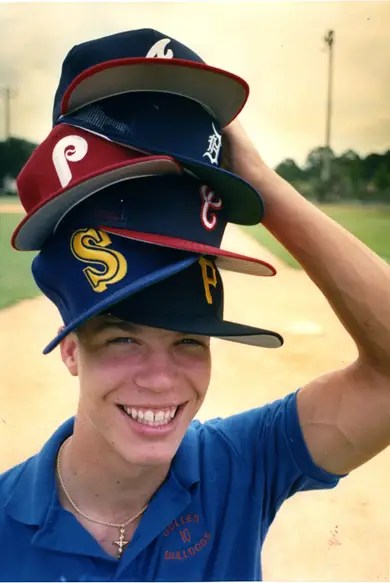
Chipper Jones was a Florida high school sports legend. He played wideout and defensive back on the gridiron and was a standout pitcher and shortstop on the diamond. He earned First Team All-State in both sports and was recruited heavily by the University of Florida to play football, but accepted a scholarship offer from the Univeristy of Miami to play baseball instead. Chipper would never take his talents to South Beach however, as he was taken 1st overall in the 1990 MLB draft by the Atlanta Braves. The Braves held the envious first pick and were said to be interested in taking a player you will see a little later on this list, Todd Van Poppel. Van Poppel made it clear that he didn’t intend to sign with the Braves if selected so Atlanta pivoted to Jones. Not a bad consolation. Chipper set the minors on fire in the Braves organization and quickly became the top prospect in baseball. If you’ve read my post on The Top Third Basemen…Of My Lifetime, you’ve seen Chipper’s lengthy list of achievements and accomplishments accumulated during his Hall of Fame career. You can’t always get what you want. But if you try sometimes, well, you might find, you get what you need.
6. Brein Taylor

The very next year following the Chipper Jones draft the Yankees held the first pick and selected Brien Taylor, a 6’3” left handed pitcher from East Carteret High School in North Carolina. Taylor had a 1.25 ERA for his high school career and struck out 213 batters in 88 innings. His 100 mph fastball probably helped out a little with that. Taylor was heralded by many as the best high school pitcher they’d ever seen. He was progressing as expected through the Yankees minor league system, making it to Double-A in 1992. He had solid ERA and strikeout numbers but had some command issues with 102 walks issued in 163 innings. The Yankees wanted Taylor to take part in an instructional league that offseason to work on his fundamentals, but Taylor declined and returned home to North Carolina. This decision would prove to be life changing. On December 18, 1993, Taylor got hurt while defending his brother Brenden in a fistfight. He injured his shoulder during the altercation and was forced to undergo surgery to repair tears in the capsule and glenoid labrum, which caused him to miss the entire 1994 season. He was never the same pitcher after the surgery. When Taylor returned to the mound in the 1995 season he had lost eight miles an hour off his fastball and was unable to throw his curveball for a strike. The Yankees started him back in low-ball for the season after the surgery and Taylor had a brutal 6.08 ERA. The next season in A-ball was even worse for Taylor. He made 9 starts, none of which he made it past the 3rd inning and had an astronomical 18.73 ERA. Taylor continued to struggle the next few seasons and was eventually released by the Yankees at the end of the 1998 season. He would sign minor league deals with the Mariners and Indians before retiring after the 2000 season. The can’t miss prospect never pitched in a MLB game and was one of the most memorable “what could’ve been” players in history.
5. Ken Griffey Jr.
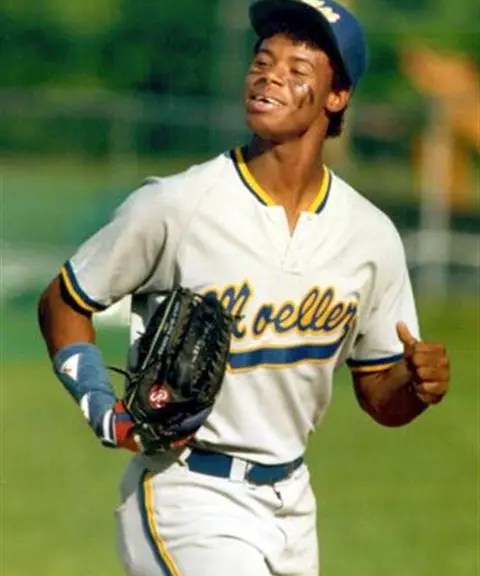
“The Kid” was the son of MLB player Ken Griffey, who enjoyed a memorable 19 year MLB career and was a member of the great “Big Red Machine” Cincinnati Reds teams of the 1970’s. Griffey Jr. was a clubhouse fixture of the Reds during this time and must’ve soaked up some of the greatness that surrounded him on a daily basis. Because Jr. was a standout baseball player at Archbishop Moeller High School in Cincinnati, where he had a career .478 career batting average. He was selected 1st overall by the Seattle Mariners in the 1987 draft. Griffey blazed through the minor leagues and was named the Mariners starting center fielder to begin the 1989 season. It was the start of a Hall of Fame career that saw Jr. become one of the legends of the game. On August 31st 1990, my 10th birthday, Griffey Jr. and Sr. became the first father-son teammates in MLB history and in a game in September of that year they actually hit back-to-back homers. A cool baseball moment for a father and his up-and-coming superstar son. Griffey was the first baseball prospect that I can remember, largely because he was drafted 1/1 and was the son of a current MLB player. He lived up to and exceeded all expectations as a top prospect.
4. Alex Rodriguez
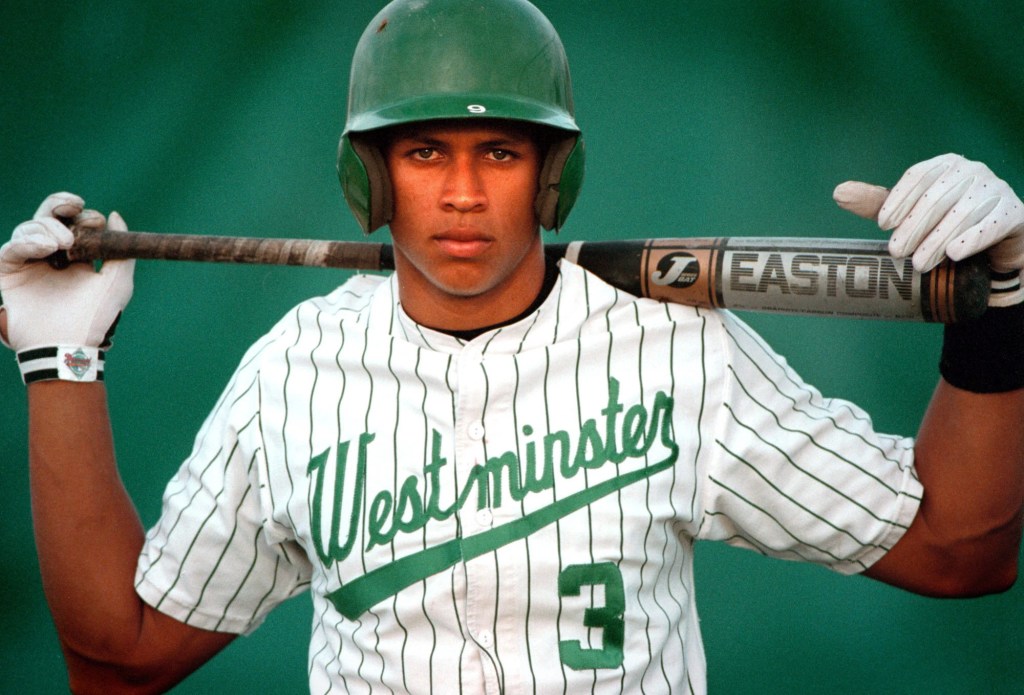
Ken Griffey Jr.’s future teammate in Seattle, Alex Rodriguez was perhaps a more highly touted prep athlete than even Jr. was. Rodriguez was a star shortstop for the baseball team and the starting quarterback for the football team at Westminster Christian School in Miami. Led by Rodriguez, Westminster won the high school national championship in baseball when he was a junior. He continued his exceptional play on the diamond in his senior season, hitting .505 with 9 HRs and 35 stolen bases in 35 attempts. He finished his high school baseball career with a career .419 average and 90 career stolen bases. A-Rod signed a letter of intent to play baseball at the University of Miami and the school also recruited him to play quarterback. He would eventually turn down the scholarship offer and enter the 1993 MLB draft, where he was selected 1st overall by the Seattle Mariners. He made his MLB debut a little over a year later, becoming just the third 18-year-old starting shortstop in the majors since 1900. I first learned about Alex Rodriguez in a Sports Illustrated article that chronicled his high school baseball career. I was instantly intrigued and A-Rod quickly became one of my favorite players, even before he’d played an inning of professional baseball. He went on to have a storied and legendary Major League career, albeit one steeped in controversy.
3. Todd Van Poppel

If you recognize the image of Todd Van Poppel pictured above, you probably collected baseball cards in the early 1990’s. And if you owned this card you probably thought it was going to make you rich beyond your wildest dreams someday. Van Poppel was a pitcher who had the hottest cards on the market, fetching higher prices than all the established big league superstars of the time. He generated such hype by dominating Texas high school baseball his senior season, going 11-3 with a 0.93 ERA with 170 strikeouts. He was selected 14th overall by the Oakland Athletics in the 1990 draft and likely would’ve gone much higher, even first overall, if not for his unwillingness to play for certain teams and the contract demands he was seeking. The A’s were willing to take the chance, mainly because they had four picks within the first 36 of the draft. They selected starting pitchers with each one and the group would soon be labeled “The Four Aces.” Van Poppel’s contract demands that I alluded to earlier led to him signing a Major League deal with the A’s instead of a normal minor league contract that is standard with draft picks. This meant that Van Poppel could only appear in a set amount of minor league games before the A’s were forced to promote him to the big league club. He made his MLB debut in September of 1991 at the age of 19. Van Poppel struggled to adjust to the majors and never really got his footing. Many attribute his troubles to his lack of experience, due to his minimal time spent in the minors. Van Poppel never came close to living up to his prospect hype but was able to grind out an 11 year big league career, mostly spent in a relief pitcher role.
2. Bryce Harper

At the tender age of 16, Bryce Harper was anointed as “The Chosen One” on the cover of Sports Illustrated. Harper was the most heralded high school baseball prodigy in history. However, his high school career only lasted two years because he left Las Vegas High School after his sophomore year so that he could attend the College of Southern Nevada, where he won the 2010 Golden Spikes Award as the nation’s best college baseball player. In 66 collegiate games Harper batted .443 with 31 HRs and 98 RBI. Oh and by the way, the SWAC, the conference his college was a member of, used wooden bats in conference play. Harper was a the consensus number 1 pick in the 2010 draft and was selected as such by the Washington Nationals. He made his MLB debut on April 27, 2012 and has had an exceptional career thus far, including winning Rookie of the Year and 2 NL MVP awards. The verdict is still out on Harper’s career as a whole, being that he’s still only 30 years old. But given the immense hype that surrounded him and the intense pressure that came with it, I would say that he has impossibly over-exceeded expectations thus far.
1. Stephen Strasburg

Unlike the other entries on this list, Stephen Strasburg was not a highly touted high school baseball player. He wasn’t selected in the draft after his high school career was over. But he’d put together a decent enough pitching resume to be recruited by some colleges and wound up enrolling at San Diego State, which was coached by MLB Hall of Famer Tony Gwynn. Strasburg was used as a relief pitcher his freshman year at SDSU before being converted to a full-time starter his sophomore season in 2008. He went 8–3 with a 1.58 ERA and 134 strikeouts in 98 innings. He only improved on those numbers in his junior year, having one of the most dominant college seasons in history. Strasburg finished his junior year 13–1 with a 1.32 ERA, and 195 strikeouts in 109 innings and rocketed up MLB teams draft boards. He was taken first overall by the Washington Nationals in the 2009 draft. One year before the previous entry on the Bryce Harper. He signed a record breaking deal and was perceived as big league-ready before having ever pitched in professional baseball. This proved to be basically true. Less than six months after his minor league debut he was called up to the majors. Strasburg picked up the win in his debut, pitching seven innings, allowing two earned runs and no walks and 14 strikeouts. The hype was real. And me and my friends bought in. Strasburg’s 5th career start was scheduled to be in Atlanta against the Braves. We scrambled to get tickets and secured some nice seats halfway up the first base line. It was late June, it was hot in Atlanta and I’d been partaking in a few adult beverages. I began sweating rather profusely. I thought it was from the heat or the alcohol but when I went to the restroom, I passed a rather large kidney stone, the rock clanging off the side of the urinal at Turner Field. Strasburg had a solid outing going 6.1 innings and striking out 7 while allowing 3 earned runs. I’ll always remember passing that kidney stone at Turner Field and the child-like excitement me and my friends had from going to a game to see The Top MLB Prospect…Of My Lifetime.
 Of My Lifetime
Leave a comment